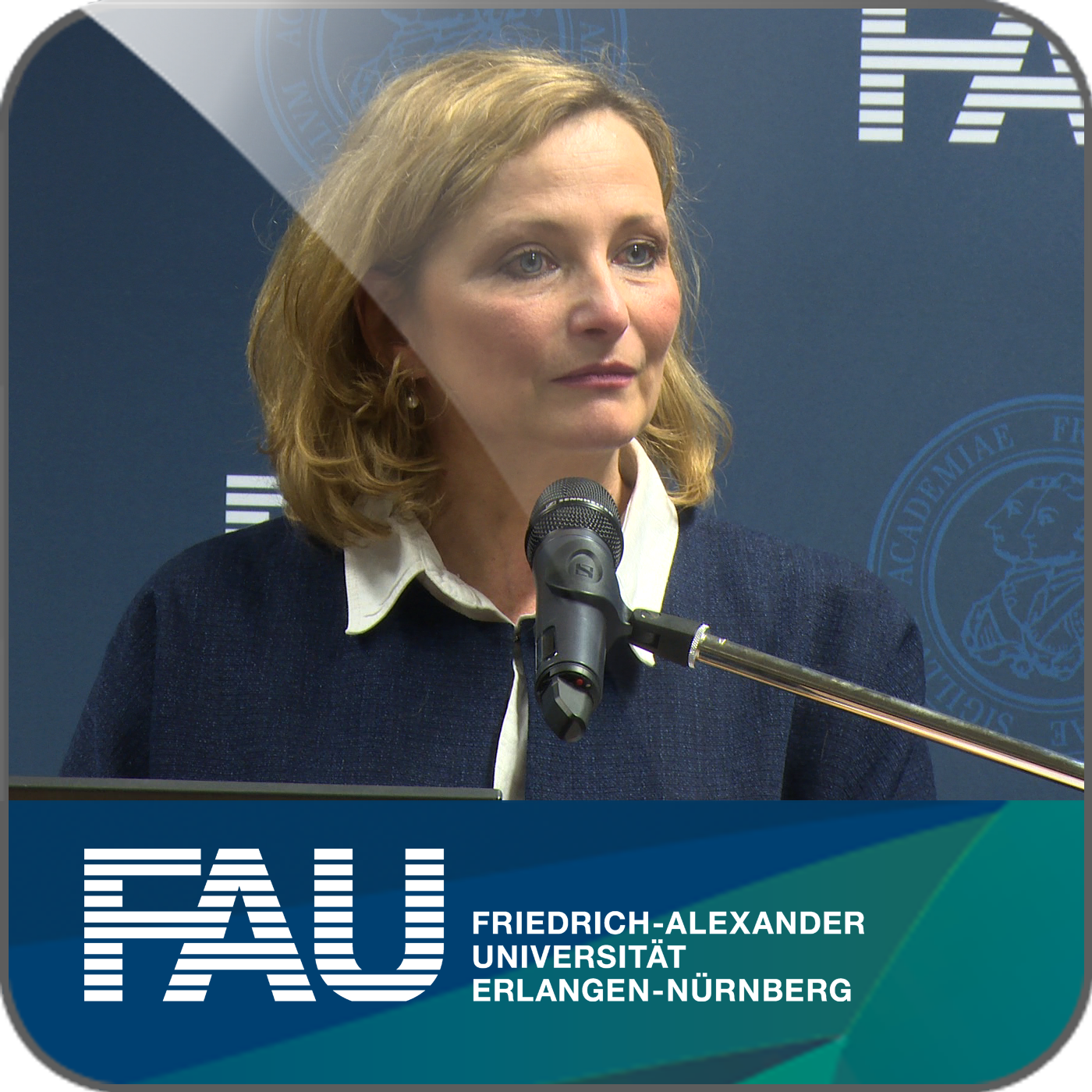
Good morning everyone. Before I start, I will start with a very, very formal remark. So this
session and the entire workshop is going to be recorded. So if you are not confident with that,
unfortunately, there is no solution unless to leave the workshop, but we hope that you're
confident with that and will stay with us. So once again, good morning everyone. My name is
Anne-Cépharra. I'm a professor for Public Law, Migration Law and Human Rights Law at the University
of Erlangen-Nürnberg and also the Vice Speaker of the Center for Human Rights Erlangen-Nürnberg,
which you have already been introduced to yesterday if you joined the workshop. But I,
well, take the opportunity to say just a few words. I'm first of all very, very happy to welcome you
all on behalf both of the CEN, the Center for Human Rights Erlangen-Nürnberg, and also of the
FFFT, the Forced Migration and Refugee Studies Project that has organized this workshop, well,
in cooperation with CREN and that is also situated at our university, of course also at other
universities, but amongst others at FAU. And we are very, very happy to have that workshop here.
And also on behalf of CREN, I can say that for our center dedicated to human rights research is
really an honor to have that project at our university and to have so many interesting
cooperations and workshops of which this is the first one, but I'm very sure that there are still
a lot to follow. So as I said, we are really especially honored to cooperate with this team
and also to host the workshop today, although unfortunately not physically in Erlangen, but at
least in this very nice Zoom format that you are all acquainted with by now, I think. Before I
introduce our second day and say a few words about what we enjoyed yesterday already, let me thank
all my colleagues who have organized this workshop, in particular Petra Bändel and Lorenz Wiese and
their entire team for putting that excellent workshop together and also for creating this
fantastic program and doing all the organization that is necessary in the background, even if it's
only an online workshop. There's still a lot of things to do. You don't have to provide coffee,
but instead you have to make sure that all the technical details are really working and that
everyone is integrated at the right point of time. So it is a lot of work and I really want to thank
you very much for that. It's a really impressive program and I already enjoyed it yesterday and
I'm still, we're gonna enjoy it again today. So yesterday we have spent the first day of the
workshop with a focus on current challenges for forced migration on the international level. So
the first panel critically evaluated the potential of the two global compacts for migration and on
refugees and one of the core issues there was that the political processes surrounding the compact
show a deep tension between state interests on the one hand and human rights principles on the
other and that by setting up the two separate compacts for refugees on the one hand and migrants
on the other hand, we risk ignoring a broad range of mobile persons that fit neither category. While
both compacts can of course be praised for being the first time on the international level that
countries of the global north and the global south actually speak together about migration
governance, the problem of fair responsibility sharing however remains unsolved and I think
that is a topic that is also gonna be concerning us also today in our discussions respective to
the European Union. Yesterday evening then we had the honor to listen to a keynote of Professor
Thomas Gameltov Hansen, one of the most outstanding international legal scholars in the field of
refugee and asylum law and in his remarkable keynote Thomas reminded us of the many changes
and developments that refugee law has undergone over the last 75 years or so. Not only have the
political circumstances changed dramatically, also the understanding and interpretation of refugee
law is in constant evolution. Thomas not only elaborately introduced us to the historic origins
of evolutive interpretation but he also introduced legal evolution as a social practice involving
constant practices of contestation and assertion of meaning. He identified a number of exogenous
and endogenous factors that determine this social practice and then concluded that an
evolutionary perspective on refugee law may help us first to look critically at decentralized
regimes that are characterizing the field of refugee law, second to recognize and understand
contradictory and competing interpretations and then finally also to develop a critical gaze of
the practices of both refugee lawyers and states in the field. In his conclusion he then tried to
Presenters
Zugänglich über
Offener Zugang
Dauer
01:54:03 Min
Aufnahmedatum
2020-07-10
Hochgeladen am
2020-07-31 14:48:37
Sprache
de-DE
Panel 2: The CEAS and the Brussels playing field (Prof. Dr. Sergio Carrera, Prof. Dr. Daniel Thym, Prof. Dr. Anuscheh Farahat; Moderation: Prof. Dr. Petra Bendel)
***
As part of the FFVT project, the CHREN organized a first workshop on July 9th and 10th, 2020. In this workshop, distinguished scientists and politicians addressed current challenges at the global, European and national levels of asylum, migration, governance and human rights: “Where do the Global Compacts on Migration and Refugees lead to?” “What ought to be done about the Common European Asylum system?” “What can reasonably be expected from the German EU Council Presidency, starting in July 2020, in the area of migration and refugees – and in view of Corona?”
***
Im Rahmen des FFVT Projekts richtete das CHREN am 9. und 10. Juli 2020 einen ersten Workshop aus. Darin bearbeiten renommierte Wissenschaftler*innen und Politiker*innen aktuelle Herausforderungen der globalen, europäischen und nationalen Ebene von Flucht, Governance und Menschenrechten im Bereich der Fluchtmigration: „Wohin führen die Globalen Pakte für Migration und Flüchtlinge?“ „Was soll im europäischen Asylsystem passieren?“ „Und was kann die im Juli 2020 beginnende deutsche EU- Ratspräsidentschaft im Bereich Migration und Flucht angesichts von Corona ausrichten?“
Den Flyer der Veranstaltung finden Sie hier.