Music
Music
Music
Music
Music
Music
Music
What is the topic of discussion about tonight?
In my presentation, I would like to give some suggestions from an Islamic perspective
about the seemingly incomprehensible dilemma between on the one hand
the claim of truth as a central element of religious traditions
and on the other hand the world openness as an anthropological constant of humanity.
In the debate on the religious plurality, one finds the common prejudice
that the monotheistic religions are not necessarily the inventors of tolerance.
One cannot ignore this prejudice in fact in the background of the history and present of the followers of religion.
This brings a deep skepticism towards the potential of peace of religions
which is becoming significantly larger with the increasing return of religions.
A central aspect of this skepticism is that the religions, in view of their
each traditional absolute claim of truth, are at all able to
– that is the question – are at all able to make a meaningful and constructive contribution
to the social structure of plurality in a peaceful form.
A dangerous example of the danger of radicalized striving for unifying order,
clarity of order and certainty in destructive and chaotic processes,
the writer Amin Malouf describes in 2000 with the phenomenon of murderous identities.
He goes into his various essays on the question of what drives so many people today
to commit crimes in the name of their religious, ethnic, national or other identity.
The main point of his facet-rich essays is the experience of failure in dealing with the complexity of identity mechanisms
as well as the radicalization of the question of belonging from the reality of fear.
The educational perspective that I take here is classically based on the idea of the plural subject.
This means, in connection with the educational researcher Benner,
the determination of people for freedom, language and history.
I am certainly not talking about an elitist discourse about the normative or ideological content of such categories and concepts,
but much more in connection with current educational studies by Mack, but also by Lothar Bönig and others
about the pedagogical contribution of such categories for the management of the plural everyday life.
To put it more concretely, for an autonomous individual development of religiously oriented youth,
the educational theoretical examination of the tension between subjective certainty of belief
and objectively indisputable openness of the human being,
to enable a possible conflict-like conflict to be overcome by the training and strengthening of their tolerance for ambiguity,
to overcome the absolute demands of truth in the pluralist society,
and to prevent it, in the best case, preventively.
The goal of the society would be to aim at realizing a normality of recognition and appreciation of religious plurality.
More than just a attitude of tolerance is certainly meant.
Because peaceful coexistence with the support of religions can only exist if religious people, on the one hand,
feel their demands on truth and connectivity seriously, and if they also practice this from a deep religious conviction against others.
That is, not only take, but also give.
I would like to highlight at this point that a peaceful formation of religious plurality is much more than just a social-political task of the present.
I see it as a genuine task of theology, or Islamic theology,
which devotes itself to the change of the increasing consciousness of Muslims as citizens of this society.
A future-oriented management of this challenge takes place in a tension of openness and originality.
For me, as a member of the newly founded Department for Islamic Religious Studies at the University of Langen-Nürnberg,
Presenters
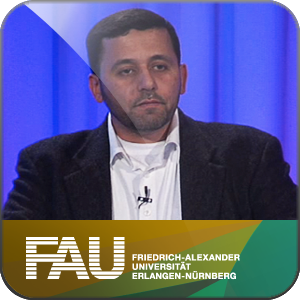 Dr. Tarek Badawia
Zugänglich über
Offener Zugang
Dauer
00:29:42 Min
Aufnahmedatum
2013-12-11
Hochgeladen am
2014-06-06 09:57:05
Sprache
de-DE